
News details
29
2026-09
Development trend of auto repair equipment industry: professional, intelligent and efficient maintenance solutions
1. Changes in automobile maintenance needs promote the continuous upgrading of automobile repair equipment
With the development of automobile technology, vehicle structure and maintenance methods are also constantly changing. Traditional basic maintenance services are gradually being combined with professional inspections, tire services, chassis maintenance and refined maintenance.
This change has put forward more diverse requirements for auto repair equipment. Maintenance companies not only need to meet regular vehicle maintenance needs, but also need to configure corresponding professional equipment according to different models, maintenance projects and working environments.
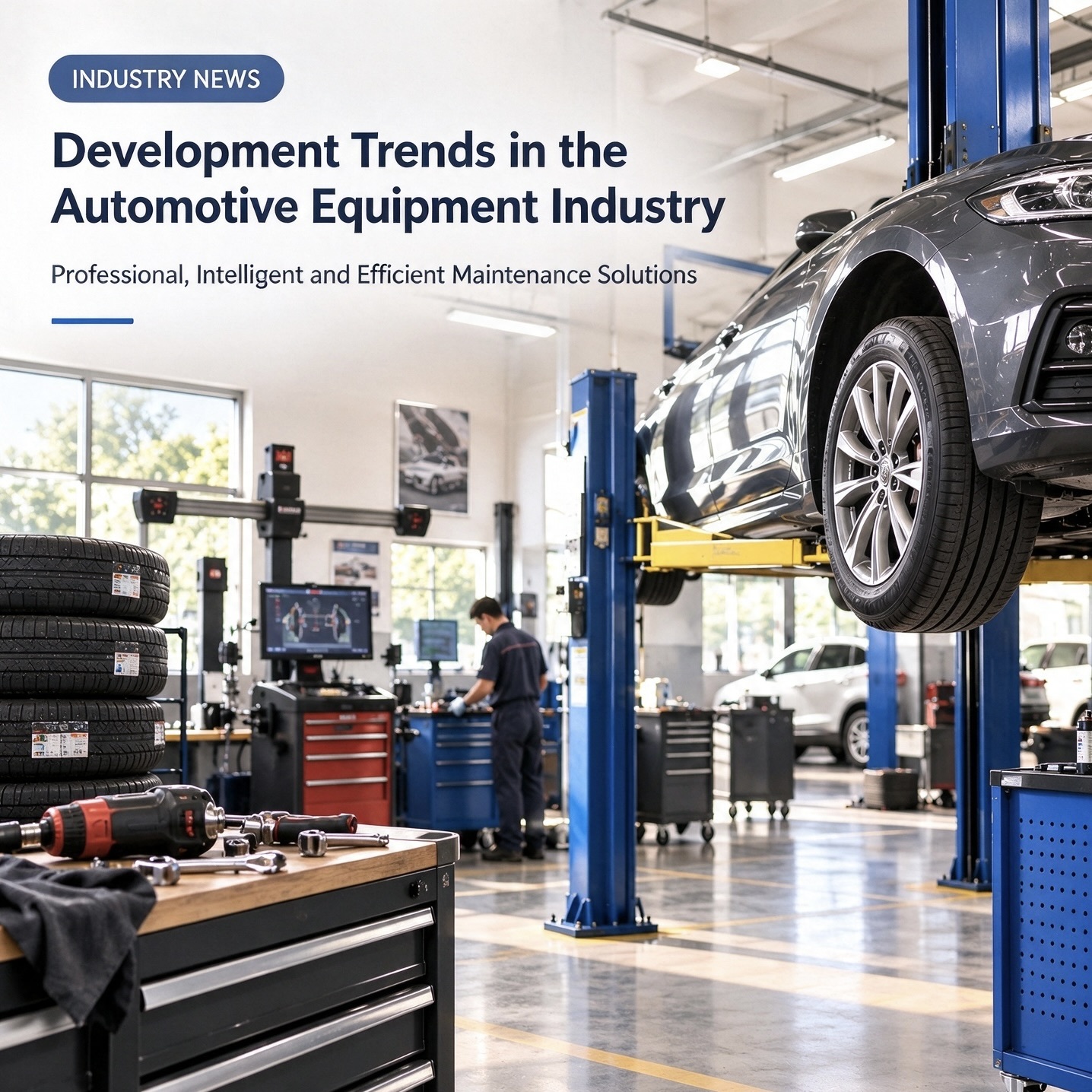
For example, during vehicle chassis maintenance, car lifts can provide more convenient working space for maintenance personnel; in tire replacement and maintenance business, tire changers and wheel balancing machines can assist in completing related operations; and four-wheel aligners can be used to detect vehicle wheel alignment parameters and provide data reference for chassis adjustment.
The reasonable configuration of professional equipment is becoming an important basis for auto repair companies to improve service projects and optimize daily operating procedures.
2. Auto repair equipment develops toward specialization and diversification
Different types of auto repair businesses have different requirements for equipment functions, carrying capacity and operation methods. Therefore, the auto repair equipment market presents a more segmented product demand.
3. Intelligent technology provides more support for car maintenance
Digital and intelligent technologies are bringing new application directions to the automobile maintenance industry.
In some modern auto repair equipment, technologies such as digital display, electronic measurement, sensors and supporting software have been used in vehicle detection, wheel alignment and equipment control. These functions can help operators obtain relevant data and carry out inspection and adjustment work according to equipment operating procedures.
Taking four-wheel alignment equipment as an example, the digital measurement system can collect wheel alignment-related parameters and present the detection results through the software interface, providing a reference for maintenance personnel to judge the vehicle alignment status.
At the same time, some new equipment is also focusing on simplification and functional integration of operating interfaces to facilitate technicians" learning and use.
It should be noted that there are differences in the degree of intelligence, measurement methods and functional configurations of different devices. When purchasing, the evaluation should be based on the actual maintenance items, the technical level of the operators, and the after-sales support conditions.
4. Maintenance efficiency and operation safety have become important factors in equipment selection.
For auto repair shops, equipment not only needs to meet maintenance functions, but also needs to adapt to daily work rhythms and comply with corresponding safe use requirements.
During the equipment selection process, maintenance companies usually need to focus on the following aspects:
-
Equipment performance: Based on vehicle type, frequency of use and maintenance items, confirm whether the technical parameters of the equipment meet actual needs.
-
Operation efficiency: Pay attention to the equipment"s operating procedures, working speed and cooperation between different maintenance links.
-
Safe design: Check safety locking, overload protection and other safety devices, and install and operate them in accordance with the manufacturer"s requirements.
-
Maintenance convenience: Understand wearing parts, daily maintenance requirements and how to deal with common faults.
-
Use space: Reasonably plan the equipment layout based on the area, floor height, power supply and ground conditions of the maintenance workshop.
Especially for load-bearing equipment such as car lifts, the installation foundation, rated load capacity, regular inspection and standardized operation are all very important. The correct use and maintenance of equipment is an important part of ensuring daily maintenance operations.
5. Auto repair equipment procurement pays more attention to long-term use value
In the process of purchasing auto repair equipment, product price is certainly an important consideration, but the long-term use cost of the equipment is also worthy of attention.
For auto repair shops, maintenance chain companies and regional dealers who plan to purchase equipment, in addition to comparing the initial purchase price, they should also comprehensively consider factors such as equipment configuration, service life, maintenance needs, parts supply and after-sales service.
For example, for repair stores with a large number of tire service businesses, they can select appropriate tire changers and wheel balancing machines based on tire specifications, workload and site conditions; for stores that need to carry out chassis repairs, they can focus on evaluating the type, load-bearing capacity and installation conditions of lifting equipment.
For wholesalers and equipment dealers, the completeness of product specifications, supply stability, packaging, transportation and technical information are also factors that need to be considered in purchasing decisions.
Configuring equipment based on actual applications can help reduce unnecessary procurement expenditures and enable equipment to better adapt to long-term operating needs.
6. Overseas auto repair equipment markets have put forward more requirements for product adaptation and supply services.
With the development of automobile aftermarket services, the purchase demand for automobile repair equipment covers different countries and regions. Different markets have differences in vehicle types, maintenance habits, workshop conditions, electrical standards and equipment certification requirements.
Therefore, when providing auto repair equipment to overseas markets, product suppliers need to fully understand the actual needs of the target market.
In terms of products, the technical parameters, scope of application, configuration options and related certification status of the equipment should be clarified; in terms of supply, attention should be paid to packaging methods, transportation conditions, delivery cycles and spare parts support.
For overseas buyers, clear product information, accurate technical communication and stable supply cooperation can help reduce information gaps in the procurement process and improve the convenience of equipment selection and subsequent use.
For auto repair equipment suppliers who want to expand overseas business, providing product information and technical support around different application scenarios is also an important part of establishing long-term customer relationships.
7. The future development direction of the auto repair equipment industry
Looking to the future, the development of the auto repair equipment industry will continue to be affected by factors such as automotive technology, maintenance service needs, and equipment manufacturing technology.
On the one hand, the segmentation of the automobile maintenance business will drive the application demand for different professional equipment. On the other hand, continuous improvements in digital inspection, equipment operation convenience and maintenance management will also provide more choices for maintenance companies.
At the same time, equipment procurement will pay more attention to practical applications and overall configuration. Maintenance companies need to reasonably plan equipment investment based on their business scale, service type and budget, while equipment manufacturers and suppliers need to continue to improve product specifications, quality management and after-sales support.
In this process,Taking into account equipment performance, use safety, maintenance convenience and actual purchasing needs will become important considerations in the selection and application of auto repair equipment.